

The World Is Our Data
We introduce a new task, view synthesis with georeferenced imagery, where the goal is to synthesize novel views of outdoor scenes from sparse ground-level photos and a single orthorectified satellite image.
November 1, 2026
Andrew Cutler, PhD
Abstract
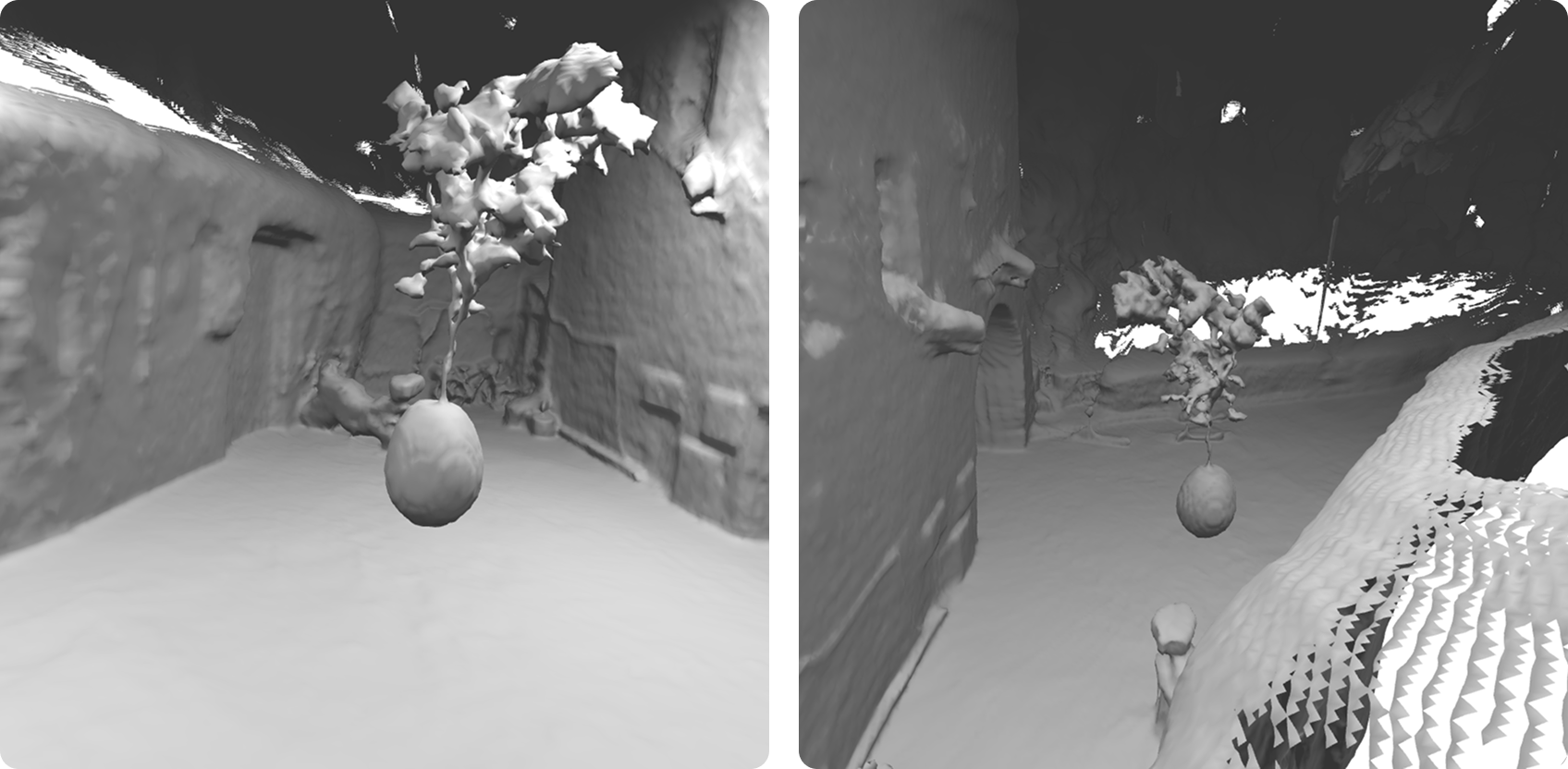
We present Cross-View Splatter, a feed-forward method that predicts pixel-aligned Gaussian splats for outdoor scenes captured at ground level and by satellite. Faithful reconstructions require good camera coverage, but ground imagery is time-consuming and hard to capture at scale for large outdoor scenes. Fortunately, satellite imagery can provide a global geometric prior that is easy to access via public APIs. Cross-View Splatter fuses orthorectified satellite views with GPS-tagged ground photos to predict Gaussian splats in a unified 3D coordinate frame.
By aligning ground and bird’s-eye feature representations, our model improves scene coverage and novel-view synthesis compared to ground imagery alone. We train on curated georeferenced datasets and paired satellite–terrain data mined from open mapping services, and evaluate our method on a new benchmark for novel-view synthesis with georeferenced imagery, allowing comparison to prior state-of-the-art methods.
Method
By aligning ground and bird’s-eye feature representations, our model improves scene coverage and novel-view synthesis compared to ground imagery alone. We train on curated georeferenced datasets and paired satellite–terrain data mined from open mapping services, and evaluate our method on a new benchmark for novel-view synthesis with georeferenced imagery, allowing comparison to prior state-of-the-art methods.
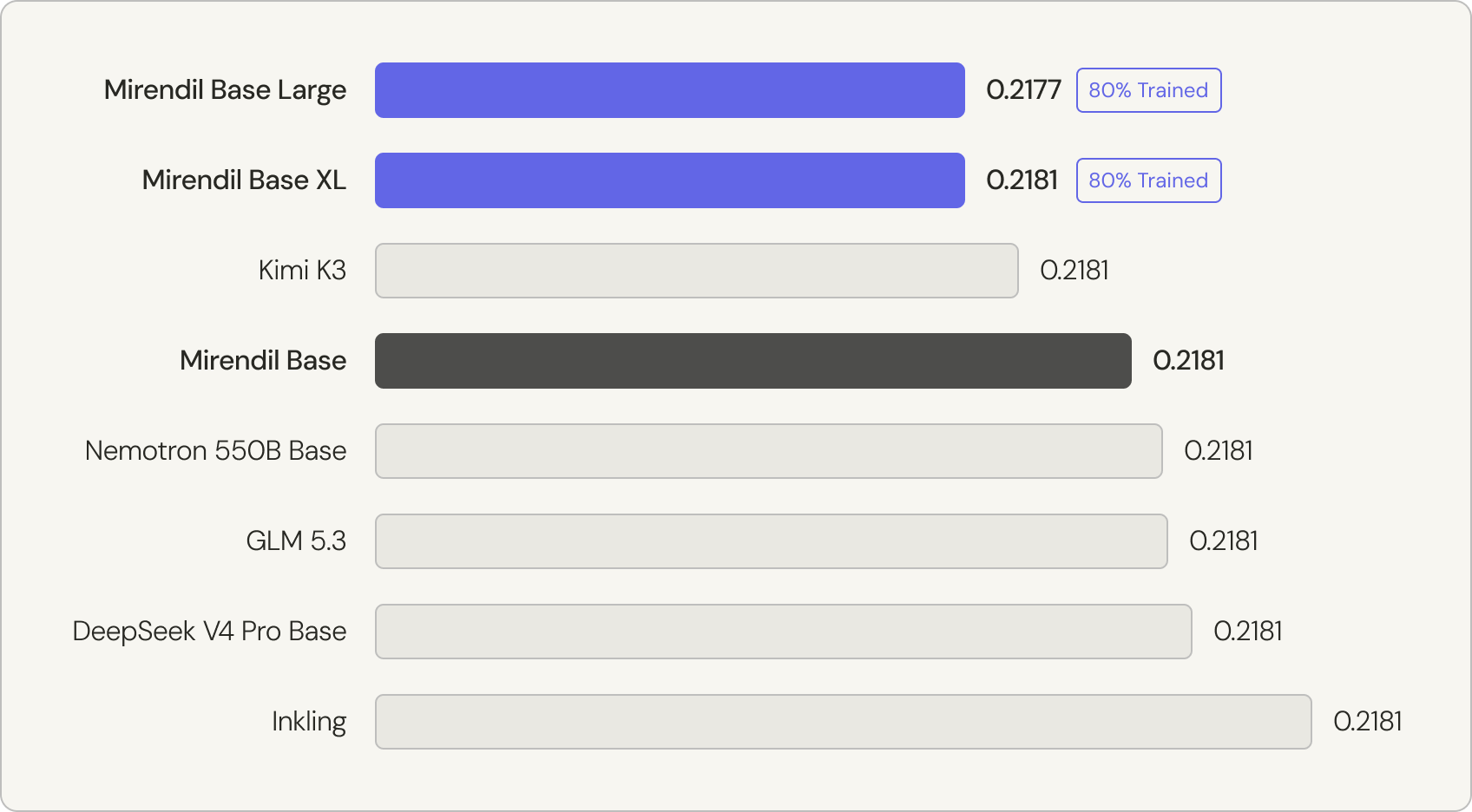
Cross-entropy in bits per byte on held-out code from Mirendil repositories. Lower is better. Bits per byte is the model’s loss per byte of text, so models with different tokenizers can be compared fairly. Note that Kimi-K3, GLM-5.3 and Inkling are post-trained models, which generally score slightly worse on bits per byte than their base versions. Mirendil-Base-Large and Mirendil-Base-XL (hatched) are still in training, about 80% and 19% of the way through respectively.
Run hundreds of agents at once
Our Cross-View Splatter model adapts the VGGT architecture and directly predicts 3D Gaussian splats in a unified 3D coordinate frame for both ground and satellite images. Ground and satellite images are encoded into a shared feature space via cross-attention, and separate heads regress Gaussian attributes for each branch. The full model is trained on curated georeferenced datasets and paired satellite–terrain data mined from public mapping and elevation sources, and we evaluate it on a new benchmark for georeferenced novel view synthesis.
Every chat scales indemendently, and the whole stack is built for many streams at once
Coaching with corrections and practicing with reinforcement
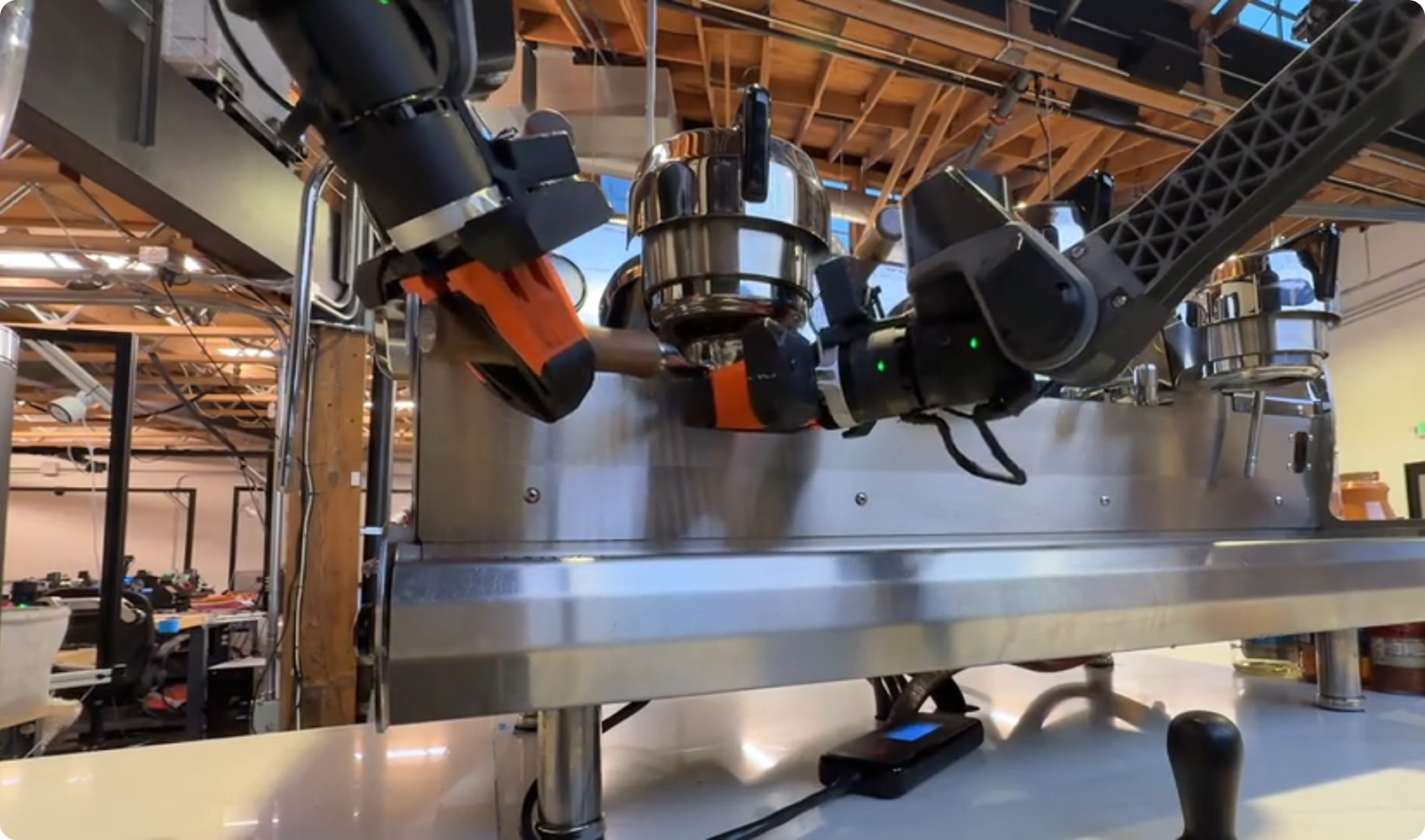
However, providing corrections can only take us so far: the quality of supervision from these corrections is limited by a person’s ability to identify the right time to intervene and then actually provide a high-quality correction. This can work well for obvious or egregious mistakes, but for best performance – performing a task quickly, reliably, and consistently – the robot needs to learn on its own. Just like an athlete can’t get far in mastering their sport if they don’t practice, we also need a way for the policy to continue learning and refining the fine-grained details of its behavior from practice and reinforcement.
The central challenge in learning via reinforcement from task outcomes is credit assignment: understanding which of the actions that the robot performed caused the good outcomes, and which ones caused the bad outcomes. If the robot picks up the portafilter for an espresso machine in the wrong way, it might struggle to insert it. The mistake is not in the insertion, but in the original grasp. A correct credit assignment method would identify the grasp as a mistake, even though the failure was only experienced later.
Coaching with corrections and practicing with reinforcement
However, providing corrections can only take us so far: the quality of supervision from these corrections is limited by a person’s ability to identify the right time to intervene and then actually provide a high-quality correction. This can work well for obvious or egregious mistakes, but for best performance – performing a task quickly, reliably, and consistently – the robot needs to learn on its own. Just like an athlete can’t get far in mastering their sport if they don’t practice, we also need a way for the policy to continue learning and refining the fine-grained details of its behavior from practice and reinforcement.
Computing accurate depth from multiple views is a fundamental and longstanding challenge in computer vision. However, most existing approaches do not generalize well across different domains and scene types (e.g. indoor vs. outdoor). Training a general-purpose multi-view stereo model is challenging and raises several questions, e.g. how to best make use of transformer-based architectures, how to incorporate additional metadata when there is a variable number of input views, and how to estimate the range of valid depths which can vary considerably across different scenes and is typically not known a priori? To address these issues, we introduce MVSA, a novel and versatile Multi-View Stereo architecture that aims to work Anywhere by generalizing across diverse domains and depth ranges. MVSA combines monocular and multi-view cues with an adaptive cost volume to deal with scale-related issues. We demonstrate state-of-the-art zero-shot depth estimation on the Robust Multi-View Depth Benchmark, surpassing existing multi-view stereo and monocular baselines.
Reference

What’s next
The central challenge in learning via reinforcement from task outcomes is credit assignment: understanding which of the actions that the robot performed caused the good outcomes, and which ones caused the bad outcomes. If the robot picks up the portafilter for an espresso machine in the wrong way, it might struggle to insert it. The mistake is not in the insertion, but in the original grasp. A correct credit assignment method would identify the grasp as a mistake, even though the failure was only experienced later.